Pomelo Farming: Commercial Cultivation Practices
A practical overview of commercial pomelo farming — propagation, orchard management, harvesting, post-harvest handling, and production economics.
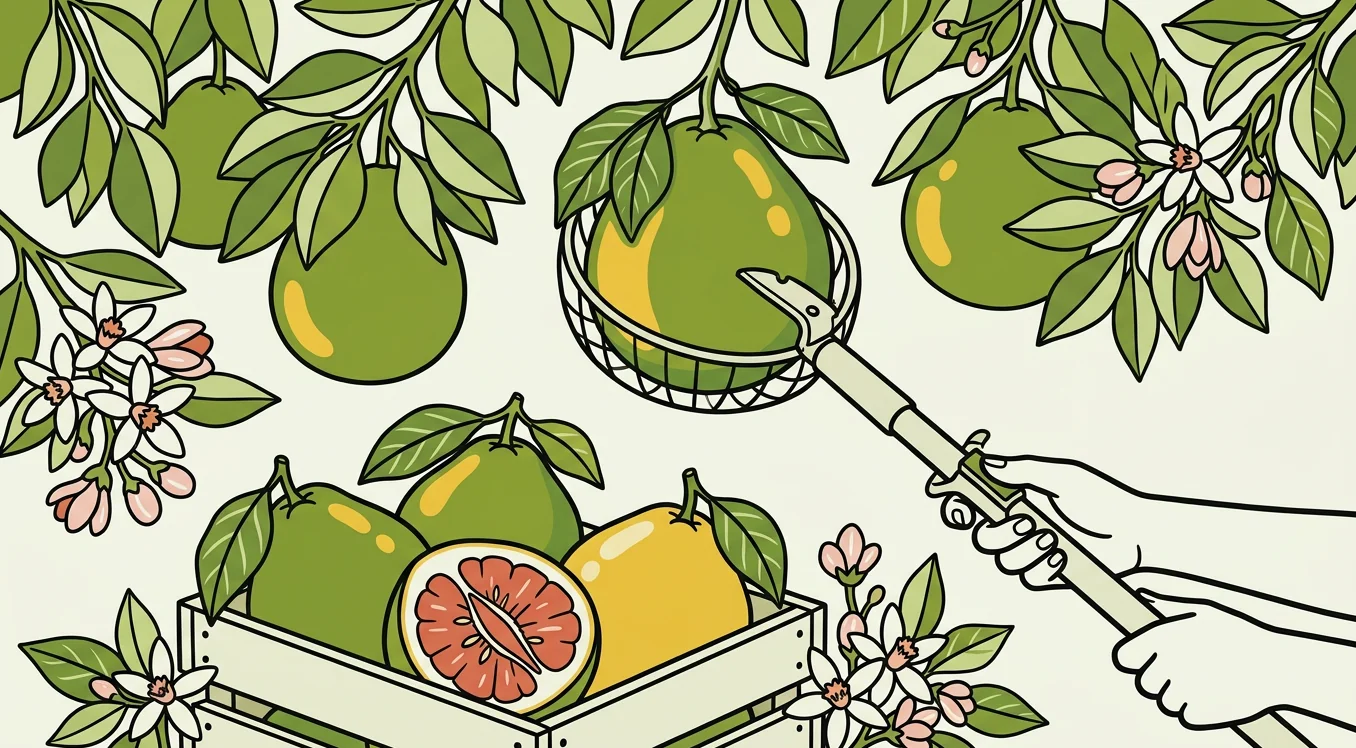
Commercial pomelo farming is concentrated in tropical and subtropical regions of Asia, where the species (Citrus maxima) has been cultivated for centuries. The basic biology is the same whether you grow one tree in a backyard or manage a 50-hectare orchard. But commercial production brings a whole different set of considerations: propagation at scale, integrated pest management, cold chain logistics, and multi-year return-on-investment calculations.
This article covers the practical realities of growing pomelo as a commercial crop. For home growing guidance, check out our pomelo tree guide.
Key Growing Regions
Commercial pomelo production is dominated by a handful of regions with the right combination of climate, infrastructure, and market access:
- Southern China (Fujian, Guangdong, Guangxi): The world’s largest production base, responsible for the majority of global output
- Central Thailand (Nakhon Pathom, Chai Nat): Premium Thongdi and Khao Tangkwa production
- Mekong Delta, Vietnam: Nam Roi and Da Xanh varieties for domestic and export markets
- Indonesia (Bali, East Java): Bali pomelo for domestic consumption
- Israel (coastal plain): Export-oriented Chandler and Sweetie production for European markets
Successful commercial cultivation requires USDA zones 10-11 or equivalent: frost-free conditions with warm, humid growing seasons and moderate dry periods before harvest to concentrate fruit sugars.
Propagation Methods
Commercial pomelo orchards are almost never established from seed. Seed-grown trees take 8-12 years to fruit, produce variable quality, and lack the disease resistance that improved rootstocks provide. (Curious about the seed-to-tree process? See our growing pomelo from seed guide.)
Grafting (Preferred Method)
T-budding and cleft grafting onto selected rootstocks is the industry standard. Common rootstock choices include:
- Rough lemon (C. jambhiri): Vigorous growth, good drought tolerance, widely used in Southeast Asia
- Volkamer lemon (C. volkameriana): Strong vigor, good fruit size, moderate salt tolerance
- Troyer/Carrizo citrange: Better cold tolerance, some tristeza resistance, common in subtropical margins
- Sour orange (C. aurantium): Excellent fruit quality, but susceptible to citrus tristeza virus and declining in use
Grafted trees typically begin producing fruit in 3-4 years, reaching full commercial production by year 6-8.
Air Layering (Marcotting)
Air layering is still used in some traditional production systems, particularly in Thailand and the Philippines. The technique produces genetically identical clones that fruit earlier than seedlings (2-3 years), but the resulting trees lack the vigor and disease resistance of grafted stock. Most modern commercial operations have moved away from this method.
Orchard Management
Spacing and Density
Pomelo trees are large. Mature specimens can reach 8-15 meters in height with broad, spreading canopies. Standard commercial spacing is 6 to 8 meters between trees (both within and between rows), yielding planting densities of approximately 150-280 trees per hectare.
Some growers are experimenting with high-density plantings (4-5 m spacing, 400+ trees/ha) with aggressive pruning to manage canopy size. This approach can increase early yields but requires more intensive labor and management.
Irrigation
Pomelo requires consistent moisture during flowering and fruit development (typically spring through fall). Commercial orchards in drier regions use:
- Drip irrigation: Most efficient; delivers water directly to the root zone
- Micro-sprinkler systems: Common in Southeast Asian orchards; also helps with humidity
- Flood/furrow irrigation: Still used in some traditional systems but increasingly replaced
Water management becomes critical in the 4-6 weeks before harvest. A controlled dry period during this window concentrates sugars and improves flavor, but excessive drought stress causes fruit drop and rind disorders.
Fertilization
Commercial pomelo orchards follow structured fertilization schedules, typically with 3-4 major applications per year:
| Timing | Focus | Typical Application |
|---|---|---|
| Post-harvest (winter) | Tree recovery | Organic matter, balanced NPK |
| Pre-bloom (early spring) | Flower development | Higher nitrogen, micronutrients (Zn, B, Mn) |
| Fruit set (late spring) | Fruit retention | Balanced NPK, calcium |
| Fruit development (summer) | Sizing and sugar accumulation | Higher potassium, reduced nitrogen |
Mature trees typically receive 1.5-3 kg of actual nitrogen per tree per year, with phosphorus and potassium adjusted based on soil tests. Foliar micronutrient sprays (zinc, boron, manganese) are standard practice, as citrus is prone to micronutrient deficiencies in alkaline soils.
Integrated Pest Management
Key pests and diseases in commercial pomelo production:
- Asian citrus psyllid (Diaphorina citri): Vector for HLB/citrus greening; monitoring and control is the top priority in affected regions
- Citrus leafminer (Phyllocnistis citrella): Damages new growth; managed with targeted insecticides or biological controls
- Fruit flies (various Bactrocera species): Fruit bagging, protein bait traps, and area-wide sterile male release programs
- Phytophthora root rot: Managed through rootstock selection, drainage, and phosphonate applications
- Citrus canker (Xanthomonas citri): Copper sprays, windbreaks, and quarantine protocols
IPM programs in modern orchards combine biological controls (parasitic wasps for psyllid and leafminer), cultural practices (sanitation, canopy management), and targeted chemical applications only when economic thresholds are exceeded.
Harvesting and Post-Harvest Handling
Harvest Timing
Pomelo is a non-climacteric fruit, meaning it doesn’t continue ripening after picking. Harvesting at the correct maturity stage is critical for flavor and marketability. Indicators of harvest readiness:
- Rind color change from green to pale yellow or golden (variety-dependent)
- Brix reading of 9-12° (sugar content measured by refractometer)
- Acid ratio declining to target levels (Brix:acid ratio of 8:1 to 12:1 preferred)
- Rind oil gland development producing characteristic aroma when scratched
- Days from bloom, typically 200-240 days depending on variety and climate
Handling and Packing
Pomelo’s thick rind provides natural protection, but careless handling still causes cosmetic damage that reduces market value. Best practices:
- Clip-cut harvesting (never pull fruit from the tree) to prevent stem-end damage
- Field sorting to remove damaged or undersized fruit
- Washing and wax coating to reduce moisture loss and improve appearance
- Individual wrapping in tissue or foam netting for premium markets
- Size grading. Typical commercial grades are large (1-1.5 kg), extra-large (1.5-2 kg), and jumbo (2+ kg).
Cold Chain
Optimal post-harvest storage conditions for pomelo:
- Temperature: 7-10°C (45-50°F). Lower temperatures cause chilling injury (rind pitting, off-flavors).
- Relative humidity: 85-90%
- Storage life: 4-8 weeks under proper conditions; 2-4 weeks at retail
For export shipments, maintaining the cold chain from packhouse to destination is the biggest logistics challenge. Sea freight from China or Thailand to the US West Coast takes 14-21 days, and temperature deviations during that window can dramatically cut shelf life. For more on how this fits into the broader pomelo trade picture, see our industry overview.
Production Economics
Yield
Pomelo yields vary widely depending on variety, tree age, management intensity, and growing conditions:
- Young trees (3-5 years): 30-80 fruits per tree
- Mature trees (8+ years): 200-400 fruits per tree
- Orchard yield (mature): 20-40 metric tons per hectare
Individual fruits typically weigh 1-3 kg, so a mature tree producing 300 fruits at an average weight of 1.5 kg yields approximately 450 kg of fruit per year.
Cost Structure and ROI
| Cost Category | % of Total Production Cost |
|---|---|
| Labor (pruning, spraying, harvesting) | 35-45% |
| Inputs (fertilizer, pesticides, water) | 20-30% |
| Land lease or opportunity cost | 10-15% |
| Post-harvest and packing | 10-15% |
| Overhead and transport | 5-10% |
The ROI timeline for a new pomelo orchard is 4-6 years, reflecting the lag between planting and commercial-volume production. In China’s major producing regions, well-managed orchards can hit payback within 4-5 years. In higher-cost environments (Israel, parts of Southeast Asia with export infrastructure investment), 5-7 years is more typical.
At mature production, revenue per hectare ranges from approximately $8,000-15,000 for commodity production to $20,000-40,000+ for premium branded or organic fruit in favorable markets.
For a broader look at the economic forces shaping the pomelo sector, see our global industry overview above.
Frequently Asked Questions
How long does it take for a commercial pomelo orchard to become profitable?
Most commercial pomelo orchards reach profitability within 4-6 years of planting, depending on establishment costs, variety, management intensity, and market prices. Grafted trees begin bearing fruit in year 3-4 but do not reach full production until year 6-8.
How many pomelos does a mature tree produce?
A well-managed mature pomelo tree (8+ years old) typically produces 200-400 fruits per year. Exceptional trees in optimal conditions can exceed 500 fruits, though fruit size may be smaller at higher crop loads.
What is the biggest challenge in commercial pomelo farming?
Citrus greening disease (HLB) is the most significant biological threat. On the management side, the multi-year lag to first harvest and the logistics of shipping a large, perishable fruit make pomelo farming more capital-intensive and patience-demanding than many other crops.
Can pomelo be grown organically at commercial scale?
Yes, though it is challenging. Organic pomelo production requires robust IPM programs, organic-approved inputs, and typically faces higher pest and disease pressure. The 30-50% price premium for organic fruit in Western markets can offset the increased management costs, but organic certification and consistent supply remain barriers for many growers.
Last updated March 9, 2026