The Pomelo's Story: History, Culture, and Botanical Origins
Explore the pomelo's fascinating journey from ancient Southeast Asia to global markets — its botanical origins, cultural significance, and role as the ancestor of modern citrus.
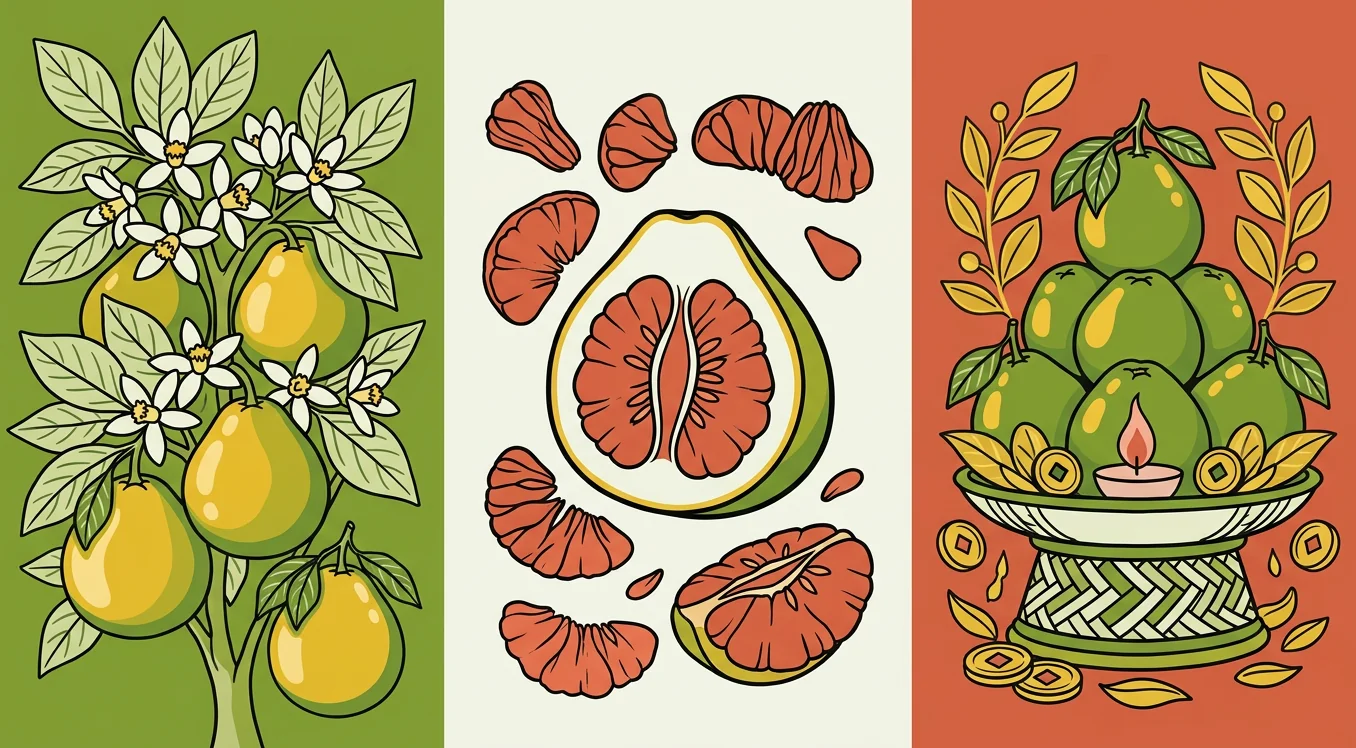

The pomelo is one of the oldest cultivated citrus species, a cornerstone of global citrus genetics, and a deeply symbolic food in cultures across Asia. Its story spans thousands of years, multiple continents, and some of the most important botanical discoveries in modern science.
Botanical Origins: One of the Original Three
Modern genomic research has identified the pomelo (Citrus maxima) as one of only three ancestral citrus species from which nearly all commercial citrus fruits descend. The other two are the mandarin (Citrus reticulata) and the citron (Citrus medica).
This means the orange, grapefruit, lemon, lime, tangelo, and dozens of other citrus varieties all trace part of their genetic heritage back to the pomelo. Researchers who mapped the genomes of dozens of citrus species confirmed the pomelo’s foundational role. The grapefruit, for example, derives about 63% of its genome from pomelo. It’s a natural hybrid of pomelo and sweet orange that arose in Barbados in the 18th century.
For a full breakdown of what makes the pomelo unique as a species, see What Is a Pomelo?.
Ancient Cultivation in Southeast Asia
The pomelo’s center of origin is Southeast Asia, spanning a region from southern China through Malaysia, Thailand, Vietnam, and the Indonesian archipelago. Archaeological and genetic evidence suggests cultivation dating back at least 4,000 years, making the pomelo one of the earliest domesticated tree fruits.
Chinese records mention pomelo cultivation during the Han Dynasty (206 BCE - 220 CE), and the fruit appears in traditional Chinese pharmacopoeia as a remedy for digestive complaints and respiratory ailments. The southern Chinese provinces of Fujian and Guangdong have been major pomelo-growing regions for centuries, with some village groves maintained continuously for over 500 years.
In Thailand, the pomelo (som-o) has been cultivated in the central plains and the Nakhon Pathom region since at least the Sukhothai period (13th-14th century). Thai pomelo varieties, particularly the Thongdi and Kao Phuang, are among the most prized cultivars in the world.
The Shaddock: A European Introduction
The pomelo arrived in the Western world through a roundabout path. The prevailing historical account traces it to an English sea captain named Captain Chaddock (sometimes spelled Shaddock), who reportedly brought pomelo seeds from the Malay Archipelago to Barbados around 1696.
This is why the fruit is still called “shaddock” in many Caribbean nations and in older English-language botanical texts. The name persists in Jamaican, Trinidadian, and Barbadian English to this day. For more on this etymology, see What Is a Shaddock?.
From the Caribbean, the pomelo spread to other parts of the Americas and continued to evolve through natural hybridization. The chance crossing of a pomelo with a sweet orange in Barbados produced the grapefruit, first described in 1750 by Griffith Hughes in The Natural History of Barbados.
Cultural Significance Across Asia
The pomelo occupies a place of honor in multiple Asian cultures, particularly in connection with festivals, family, and prosperity.
Chinese Culture
In Chinese tradition, the pomelo (youzi, ) symbolizes abundance, prosperity, and good fortune. The association is partly linguistic: in several Chinese dialects, the word for pomelo sounds similar to words meaning “to have” or “again,” suggesting continued prosperity.
During Chinese New Year, pomelos are displayed on altars, given as gifts, and served at reunion dinners. The round shape of the fruit represents completeness and family unity. During the Mid-Autumn Festival, pomelos are offered to the moon, and children traditionally wear pomelo-rind “hats,” a folk custom that has endured for centuries.
Southeast Asian Traditions
In Thailand, pomelo is associated with hospitality and is often presented to guests as a gesture of welcome. Thai Buddhist ceremonies sometimes include pomelo among fruit offerings at temple altars.
In Vietnam, pomelo features prominently during Tết (Lunar New Year), where it serves the same symbolic role as in Chinese culture. Vietnamese families display pomelos alongside other fruits on the mâm ngũ quả (five-fruit tray), each fruit representing a different wish for the new year.
In Malaysia and Indonesia, pomelo (limau besar or jeruk bali) appears at harvest festivals and family celebrations, valued both for its size (symbolizing abundance) and its longevity. The thick rind keeps the fruit fresh for weeks.
For a deeper exploration of pomelo symbolism, see The Cultural Meaning of Pomelo.
Indian Subcontinent
In parts of India, the pomelo (chakotra in Hindi, batabilebu in Bengali) is used in religious offerings and traditional Ayurvedic medicine. The fruit and its peel are used to treat digestive ailments, and pomelo trees are sometimes planted near temples for their fragrant blossoms.
The Name “Pomelo”
The word “pomelo” has a disputed etymology. The most widely accepted theory traces it through Dutch or Portuguese from a Malay or Tamil root. Alternative theories connect it to the French pomme (apple) combined with melon, suggesting it was named as a “melon-apple” by early European traders.
The fruit goes by many names worldwide:
- Pomelo / pummelo / pommelo — English (multiple spellings accepted)
- Shaddock — Caribbean English
- Youzi () — Mandarin Chinese
- Som-o — Thai
- Bưởi — Vietnamese
- Jeruk bali — Indonesian/Malay
- Jabong — Filipino
- Chakotra — Hindi
- Bontan / buntan — Japanese
The botanical name Citrus maxima (literally “greatest citrus”) was formalized by Burmann in 1768 and remains the accepted scientific classification, though Citrus grandis appears in older literature.
The Pomelo’s Genetic Legacy
Perhaps the pomelo’s greatest contribution to human civilization is invisible: its genetics. Through natural hybridization over thousands of years, the pomelo has contributed its DNA to some of the world’s most commercially important fruits:
- Grapefruit (Citrus x paradisi): ~63% pomelo genome. Natural hybrid with sweet orange.
- Sweet orange (Citrus sinensis): ~42% pomelo genome. Ancient hybrid of pomelo and mandarin.
- Sour/bitter orange (Citrus aurantium): Pomelo x mandarin hybrid. Used as rootstock and in marmalade.
- Lemon (Citrus limon): Contains pomelo genetic material via its sour orange parentage.
- Tangelo: Intentional hybrid of tangerine and grapefruit, carrying pomelo genes through the grapefruit parent.
- Oro Blanco / Melogold: Modern pomelo x grapefruit hybrids developed at UC Riverside.
This makes the pomelo one of the most genetically influential fruit species in agriculture. Understanding the pomelo’s genome has become critical to citrus breeding programs worldwide, particularly in the fight against citrus greening disease (Huanglongbing/HLB).
Modern Cultivation and Global Spread
Today, pomelos are grown commercially in tropical and subtropical regions around the world:
- China produces the vast majority of the world’s pomelos, with major growing regions in Fujian, Guangdong, Guangxi, and Sichuan provinces
- Thailand is the second-largest producer, with Nakhon Pathom province producing premium cultivars
- Vietnam, Indonesia, and Malaysia have significant production for domestic markets
- United States: California (Chandler variety), Florida, and Texas grow pomelos on a smaller scale
- Israel has developed commercial pomelo production in the Negev region
Global trade in pomelos has expanded significantly since 2000, driven by growing Asian diaspora communities in Western countries and increasing interest in exotic citrus among mainstream consumers. The fruit is now commonly available in major supermarkets in North America, Europe, and Australia during the November-February peak season. Check out our pomelo buying guide for tips on picking the best fruit.
Last updated March 9, 2026